An operating system for hospital power infrastructure.
At Dow University of Health Sciences, power equipment protects patient care, and every missed service visit carries real consequences. Infin8Scale is building the system that runs the maintenance contract behind it.
A hospital's uninterruptible power supply is not back-office equipment. It stands between a mains failure and the machines keeping patients alive. Across multiple campuses, hundreds of UPS units each need servicing, monitoring, and fast repair, on a contract where a missed visit is not a paperwork problem, it's a clinical risk.
The work was real and the team was capable. What was missing was a system to hold it: to know the state of every unit, dispatch the right technician, and prove the contract was being met.
Presented as real scope, not projected results
From registers and calls to one flow.
The system replaces registers, phone calls, and memory with a single operating flow, where each stage of the contract is a record, not a recollection.
Every fault report enters one front door and is tracked from raised to resolved, with nothing lost between a phone call and a fix.
Work is routed to a technician with clear ownership and a running clock, not handed out over WhatsApp and hoped for.
Response and resolution times are measured against the contract as they happen, so a breach is visible before it becomes a penalty.
Scheduled service is planned ahead of failure and chased automatically, so units are maintained before they fault, not after.
Reports for the client are generated from the work itself, current and consistent, rather than rebuilt by hand each period.
One live view of the whole fleet: what's operational, what needs attention, and what's down, for the office and the field alike.
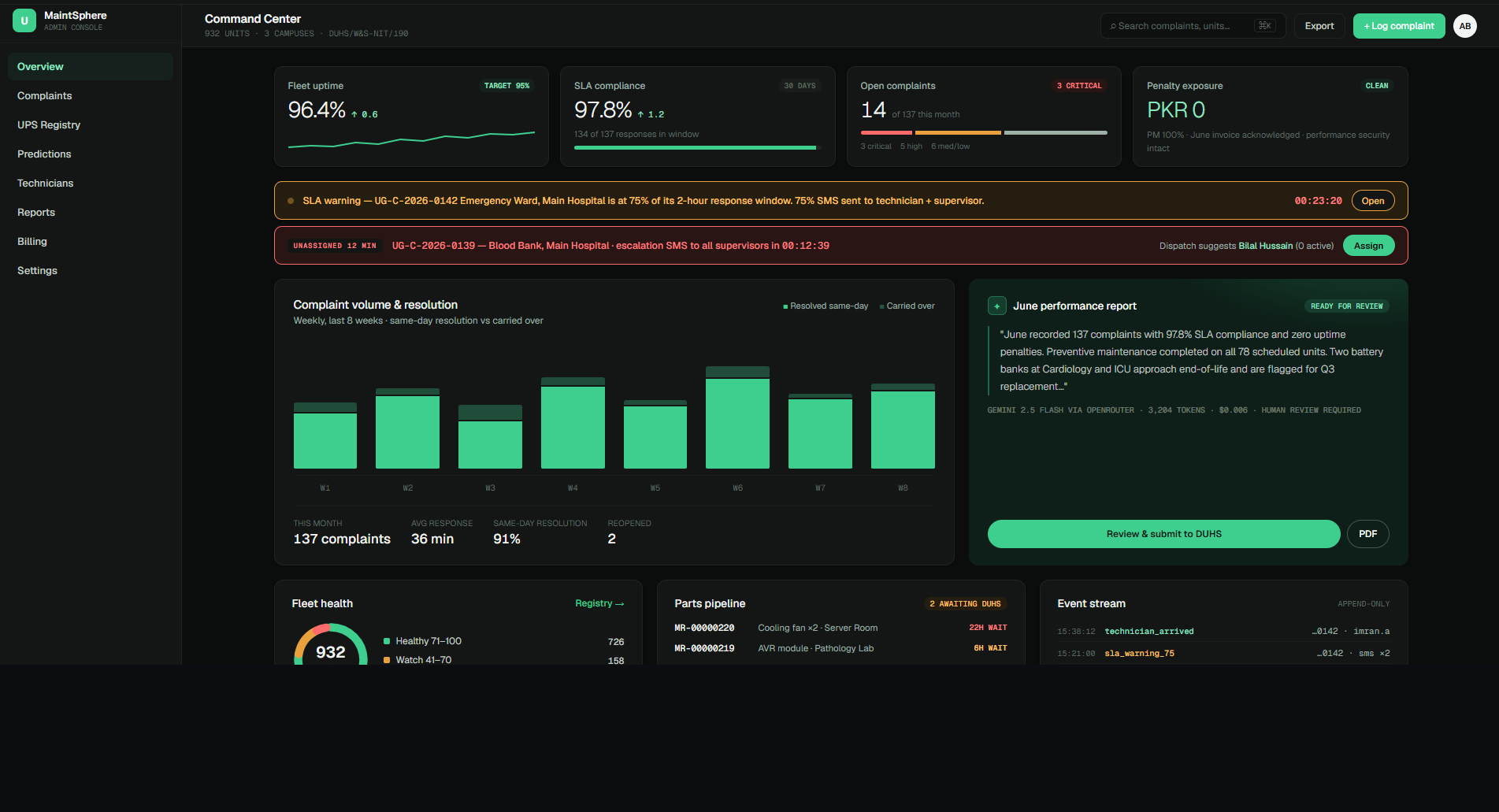
Live deployment view · the command center running the DUHS contract
Direct access to real field operations, dispatch, maintenance, SLAs, and compliance, inside the exact environments Infin8Scale systems are built for. Our systems are designed from observed operations, not assumptions.
Have an operation like this?
If power, equipment, or field service failing quietly is a risk you carry, the discovery call is where we find out what a system would change first.